National Palace of Pena & Park: Entry Ticket
4.1 / 5 4.1 · 8,326 reviews
Visit this historic fairy-tale castle and walk around the gardens
- from
- €22.40
This is not the official website
pena-palace.pt is an independent travel guide. We are not Parques de Sintra – Monte da Lua, S.A. and we are not affiliated with them. We do not sell tickets: the buttons lead to authorised resellers (Tiqets), who may pay us a commission at no extra cost to you. Opening hours, prices and conditions are reproduced from official sources and can change — always confirm on parquesdesintra.pt.
Museum circuit · 45 to 60 minutes
The inside of Pena is two buildings folded into each other: a 16th-century monastery and a 19th-century palace. Knowing where one ends and the other begins changes the whole visit.
Live prices and availability. Booking is completed on the Tiqets website.
Loading availability…
Official hours and prices as published by parquesdesintra.pt.
Most people go inside Pena Palace looking for the colours of the façade and leave surprised: what dominates indoors is not exoticism — it is domestic scale. These were the private apartments of a royal family who spent seasons here, and many rooms sit exactly as they were left in 1910.
The circuit runs one way and crosses two distinct buildings. The first half is the old Monastery of Our Lady of Pena, a Hieronymite house from the early 16th century. The second is the palace Ferdinand II began raising in 1838. The seam between the two is what makes the building unique.
Two storeys of stone arcading faced in Hispano-Moresque tile. It is the oldest element of the complex and it survived the 1755 earthquake — the rest of the monastery did not. Look closely at the tiles: they are ridged and moulded, a technique that predates the flat painted tilework which takes over Lisbon from the 17th century.
The alabaster and marble altarpiece is the most important work of art in the palace. It was commissioned by King Manuel I and carved by Nicolau Chanterene, a French-born sculptor who worked at Coimbra and on the Jerónimos monastery, around 1529. Hold the context in your head: when it was made, the palace around it was more than three centuries away from existing.
What is now the dining room was the monks' refectory. The vaulted ceiling and exposed stone give away the origin; the laid table and the china are 19th-century additions. It is the clearest example of how Ferdinand II reused rather than demolished.
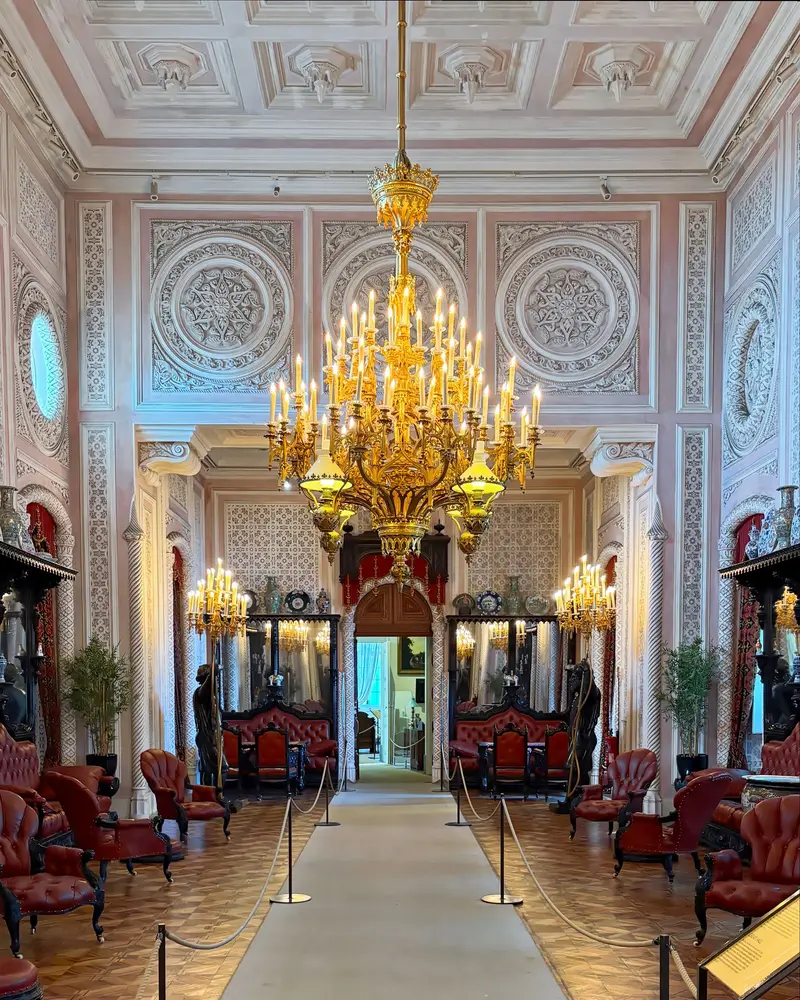
The largest room in the palace, with stained glass, chandeliers and ceremonial furniture. This is where the scale changes: everything else on the route is intimate, this room was built to receive.
Walls and ceiling painted in trompe l'œil, imitating Moorish-inspired plasterwork and tiling. There is not a single real tile in this room — all of it is paint. It is the most photographed space inside and the one that best explains the Romantic taste for an imagined Orient.
The private apartments of Ferdinand II, of King Carlos and of Queen Amélia keep their furniture, personal objects and Carlos's painting studio — he was a painter with a serious body of work. These are the rooms where you realise this was a lived-in house, not a set.
Possibly the most surprising room: worktops, ranges and a collection of copperware carrying the royal monogram. It sits at the end of the route and plenty of people hurry through it because they are already tired — a mistake, it is one of the most complete rooms in the palace.
On the way out, the carved arch with a half-man, half-fish figure over a cluster of coral. It is an allegory of the creation of the world, and the most-cited decorative element in the building. You see it from outside, in the arcaded courtyard.
The Great Hall: the only room on the route designed to receive rather than to live in.
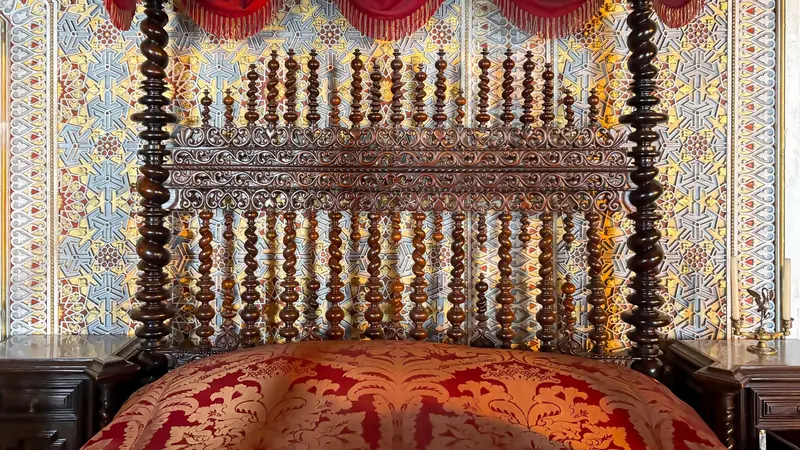
The private apartments keep their furniture and objects as they stood in 1910.
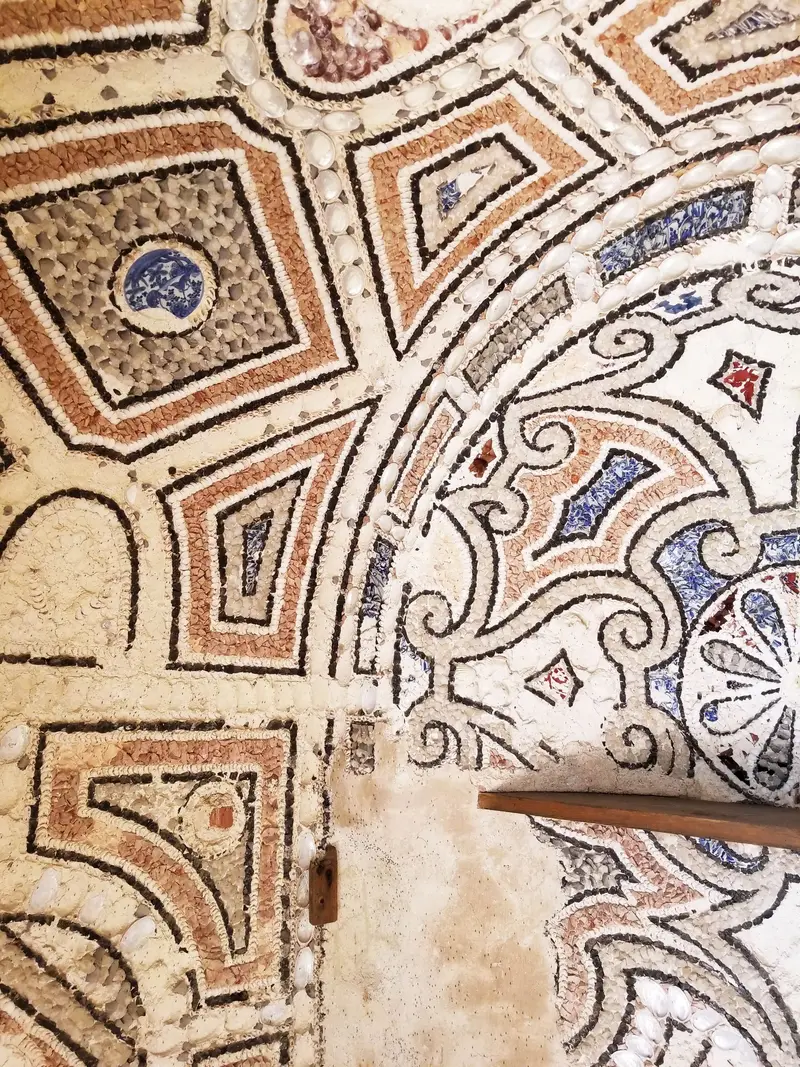
In the Arab Room, what reads as tile and plasterwork is trompe l’œil painting.
The difference between the two tickets is not the park — it is how many rooms open. The Essential Visit, €20, covers the core of the circuit: cloister, chapel, ceremonial rooms and the main apartments. The Complete Visit, €45, adds rooms on the extended circuit.
For a first visit, Essential does the job. Stepping up to Complete pays in two cases: you have been to Pena before and want what you missed, or you are travelling with 6–17-year-olds — in that band Complete costs €20 against €18 for Essential, which is not a real difference.
Live prices and availability. Booking is completed on the Tiqets website.
4.1 / 5 4.1 · 8,326 reviews
Visit this historic fairy-tale castle and walk around the gardens
Tour the royal rooms and stroll through the palace grounds
5 / 5 5.0 · 1 reviews
See intricate decor and learn about this site's history
Follow in the steps of the Queen, a Red Cross nurse who championed the arts
3.8 / 5 3.8 · 366 reviews
Skip the line to see this colorful castle in Sintra
Between 45 and 60 minutes on the main circuit. With an audio guide, add another 30 to 45. The route runs one way and you cannot double back.
On a first visit with time in hand, it is worth it: the Manueline cloister, the Chanterene altarpiece and the Arab Room have no equivalent outdoors. If you are short of time or with small children, the park alone makes a satisfying visit.
Yes, without flash and without a tripod. The rooms are kept dim for conservation reasons.
A room whose walls and ceiling are painted in trompe l’œil, imitating Moorish-inspired plasterwork and tiling. All the decoration is paint; there is no real tile.
The Manueline cloister and the chapel, from the former Monastery of Our Lady of Pena, early 16th century. The chapel’s alabaster and marble altarpiece is by Nicolau Chanterene, around 1529.
Partly. The circuit crosses the old monastic quarter, with stairs and narrow passages that cannot be altered. Confirm current conditions with Parques de Sintra.