National Palace of Pena & Park: Guided Tour
5 / 5 5.0 · 1 reviews
See intricate decor and learn about this site's history
- from
- €75.00
This is not the official website
pena-palace.pt is an independent travel guide. We are not Parques de Sintra – Monte da Lua, S.A. and we are not affiliated with them. We do not sell tickets: the buttons lead to authorised resellers (Tiqets), who may pay us a commission at no extra cost to you. Opening hours, prices and conditions are reproduced from official sources and can change — always confirm on parquesdesintra.pt.
From monastery to palace · 1511 – 1910
Pena was not built by a Portuguese king. It was built by a German prince married to a Portuguese queen, on the ruins of a monastery, twenty-five years before Bavaria’s Neuschwanstein.
Live prices and availability. Booking is completed on the Tiqets website.
Loading availability…
The history of Pena Palace comes in two very different halves, and the building tells both at once. The first is religious and runs three centuries. The second is Romantic, political and runs seventy years. What you visit today is one folded into the other.
15th c.
A chapel dedicated to Our Lady of Pena stands on the site, a place of pilgrimage at the top of the Sintra hills.
1511
King Manuel I orders a monastery of the Order of St Jerome built here, housing around eighteen monks. The Manueline cloister you can still walk dates from this phase.
c. 1529
Nicolau Chanterene carves the chapel altarpiece in alabaster and marble, commissioned by Manuel I. It is the oldest and most valuable work of art on the site.
1755
The tremor of 1 November flattens the monastery. Chapel and cloister survive, partly damaged; the rest is left in ruins and stays that way for decades.
1834
With the dissolution of religious orders in Portugal, the property passes to the state and is put up for sale.
1838
Ferdinand of Saxe-Coburg and Gotha, king consort to Maria II and cousin to Albert of England, acquires the ruined monastery and the surrounding hills. Rebuilding starts immediately.
1840–1854
Baron Wilhelm Ludwig von Eschwege directs the work. The programme mixes neo-Gothic, neo-Manueline, neo-Moorish and neo-Renaissance references — the language of European Romanticism applied to a Portuguese site.
1840s
In parallel, Ferdinand II plants 85 hectares of garden over bare rock, with species brought from across the world. It is one of Europe’s first acclimatisation parks.
1869
Widowed, Ferdinand II marries Elise Hensler, a Swiss-American opera singer given the title Countess of Edla. The couple build the Chalet at the western edge of the park.
1885
The palace passes by inheritance to the Countess of Edla and is later acquired by the Portuguese state, remaining in use by the royal family.
1910
With the Republic declared, Queen Amélia leaves for exile. The palace is listed as a national monument and turned into a museum. Many rooms stay exactly as they were left.
1995
The Cultural Landscape of Sintra is inscribed on the UNESCO World Heritage list, with Pena Palace as its symbolic centre.
Ferdinand Augustus of Saxe-Coburg and Gotha was born in Vienna in 1816 and arrived in Portugal at twenty, to marry Queen Maria II. He never reigned in his own right — he was king consort, and regent for a short period — but his cultural influence exceeded that of any Portuguese monarch of the 19th century.
He was a draughtsman, watercolourist, engraver and ceramicist. He took a serious interest in botany, in monument conservation and in opera. He became known as "the artist king", and Pena is his manifesto: not a residence for display, but a total composition in which architecture, garden and landscape were conceived as a single work.
The comparison with Ludwig II of Bavaria is unavoidable, but the chronology runs the opposite way to what most people assume: Pena began in 1838; Neuschwanstein only in 1869.
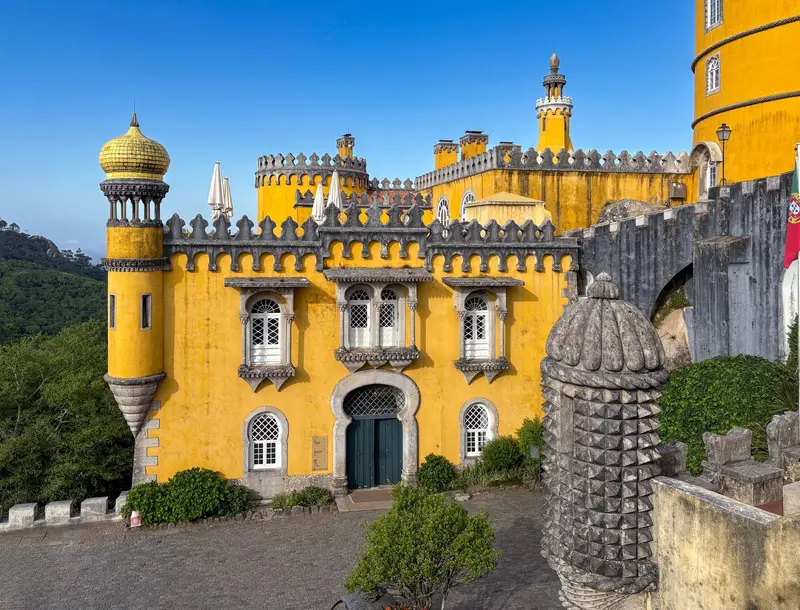
The yellow, the red and the grey-lilac are neither a contemporary choice nor a tourism invention. They correspond to the original 19th-century polychromy, documented in period sources.
For much of the 20th century the palace was painted a uniform grey, the result of paint degradation and of later restoration decisions. The colours were reinstated from the 1990s onwards, based on stratigraphic analysis of the paint layers. Anyone who visited Pena before that saw a very different building — and one far less like what Ferdinand II built.
Formats that go deeper into the history of the palace and the royal family.
5 / 5 5.0 · 1 reviews
See intricate decor and learn about this site's history
Follow in the steps of the Queen, a Red Cross nurse who championed the arts
Tour the royal rooms and stroll through the palace grounds
Ferdinand II of Saxe-Coburg and Gotha, king consort to Maria II, who bought the ruined monastery in 1838 and began rebuilding it as the royal family’s summer palace.
Construction began in 1838, after the ruins were purchased, with the main phase running from 1840 to 1854 under Baron von Eschwege. A Hieronymite monastery had stood on the site since 1511.
A monastery of the Order of St Jerome, ordered by King Manuel I in 1511 and destroyed by the 1755 earthquake. The Manueline cloister and the chapel survived and were absorbed into the palace.
Pena came first: it began in 1838, against 1869 for the Bavarian castle. Both share the same European Romantic matrix, but there is no documented direct link between the two projects.
Ferdinand II, the Countess of Edla and, later, the Portuguese royal family including King Carlos and Queen Amélia. Amélia left for exile in 1910 when the Republic was declared.
That is the original 19th-century polychromy, reinstated from the 1990s based on analysis of the paint layers. For much of the 20th century the building was painted grey.